How modern FDM is replacing premium-priced MJF
FDM grew up. For a growing list of production parts that used to default to MJF, today's industrial filament printers deliver the same performance at a fraction of the cost.
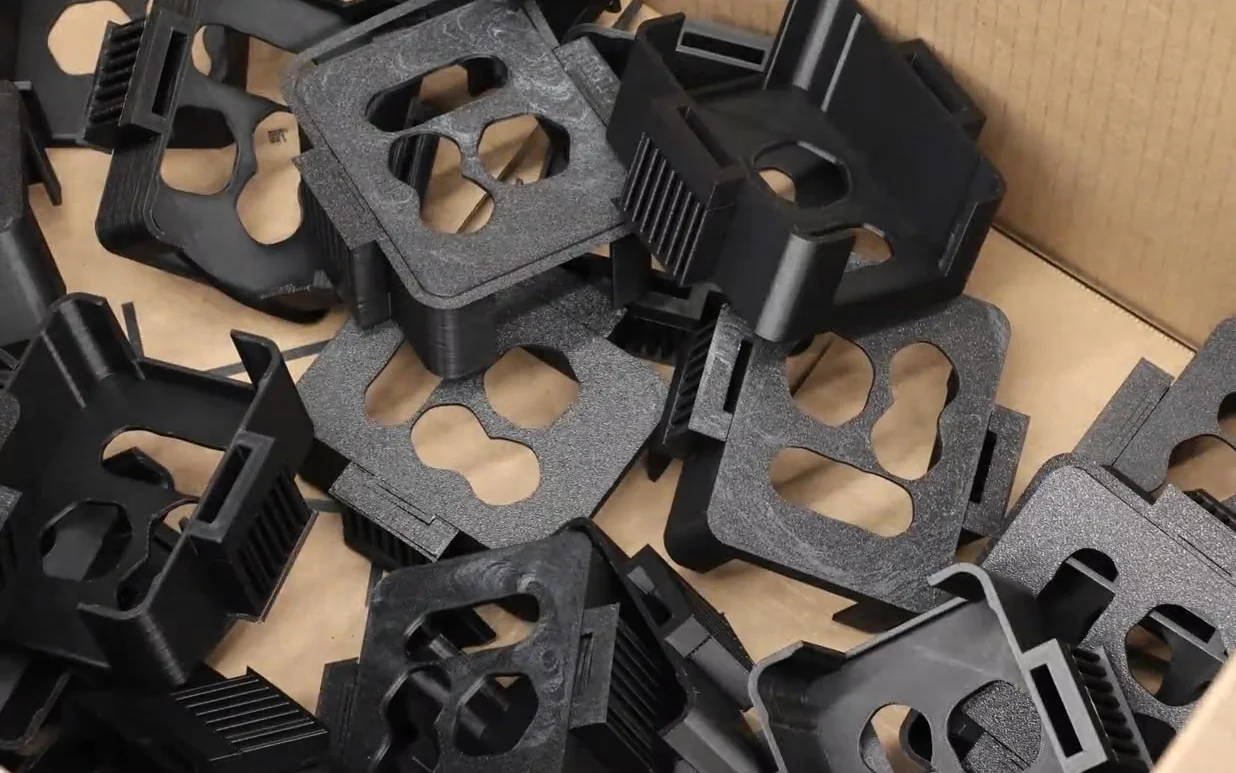
From hobbyist to production floor
A decade ago, FDM was the printer in someone's garage — fine for visual prototypes, not much else. Today the picture looks completely different. Industrial-grade FDM systems print engineering thermoplastics with the dimensional accuracy, surface quality, and material performance that used to live exclusively in powder-bed processes like MJF.
The result: for a growing list of parts, FDM has quietly become the right answer. Not just for prototypes — for end-use production.
What changed
A few shifts pulled FDM into the production conversation:
- High-temperature, all-metal hotends that handle carbon-fiber composites and engineering nylons reliably
- Heated chambers that print warp-prone materials like ABS, PC, and PA6-CF at full dimensional accuracy
- Smarter slicers and toolpath planning that produce stronger, more isotropic prints than older FDM ever could
- A much wider material library — engineering nylons, carbon and glass composites, ESD-safe and flame-retardant compounds, plus a deep palette of colors and finishes
Put those together and you get parts that compete head-to-head with MJF across a long list of applications — at a meaningful cost advantage.
Why fleet scale matters
At Incept 3D, we run hundreds of production FDM machines. That fleet is what turns FDM into a real MJF alternative rather than a tradeoff.
Volume on MJF means waiting for a full build to nest. With hundreds of FDM machines, we can spin up a production run almost immediately, parallelize across the floor, and ship quantities most service bureaus would route to MJF in days, not weeks.
That agility — plus a deep bench of materials — is why a part that "needs MJF" often doesn't.
When FDM is the better call
A few signs your part is a candidate for FDM over MJF:
- You need it fast — hours or days, not weeks
- You need a specific color, surface finish, or aesthetic that MJF can't deliver
- You need a material MJF doesn't offer (TPU, ABS, PC, carbon-fiber composites)
- Volume is moderate — single units to a few hundred
- Price matters, and the mechanical specs allow a thermoplastic alternative
PET-CF: the closest match
If you're swapping a part out of MJF, PET-CF is usually the right starting material.
PET-CF — carbon-fiber-reinforced PET — gives you:
- A premium matte black finish that reads as industrial as MJF parts
- High stiffness and dimensional stability under load
- Excellent chemical and moisture resistance
- A finish that's clean enough for customer-facing assemblies
For jigs, fixtures, drone arms, robotics mounts, and structural brackets — PET-CF on a modern FDM machine delivers what MJF nylon delivers, faster and for less.
When MJF still wins
None of this is to say MJF is obsolete. There are cases where it's the right call:
- True production volumes — thousands of identical parts, where powder-bed economics outweigh per-print cost
- Highly intricate geometries where FDM supports would compromise the finished part
- Strict isotropic mechanical performance that even well-oriented FDM can't quite match
But for the long tail of production jobs that historically defaulted to MJF — there's now a better option waiting on an FDM printer.
How to start
The fastest way to find out if your part is a candidate: submit your file. We'll quote it across every applicable material and process, and our engineering team will flag where FDM (especially PET-CF) is the more economical equivalent. Recommendations are free.